
When planning a wedding for 100 guests, one of the most common questions couples ask is: How much should we budget for the cake?
The answer depends largely on what you want the cake to be.
A traditional wedding cake from a bakery might cost several hundred dollars to a few thousand, depending on its size, flavors, and decoration. At the other end of the spectrum, a wedding cake can become an individually commissioned work of art—developed specifically for the couple, the celebration, and the space it will inhabit.
At that level, the number of servings is only one small part of what determines the cost.
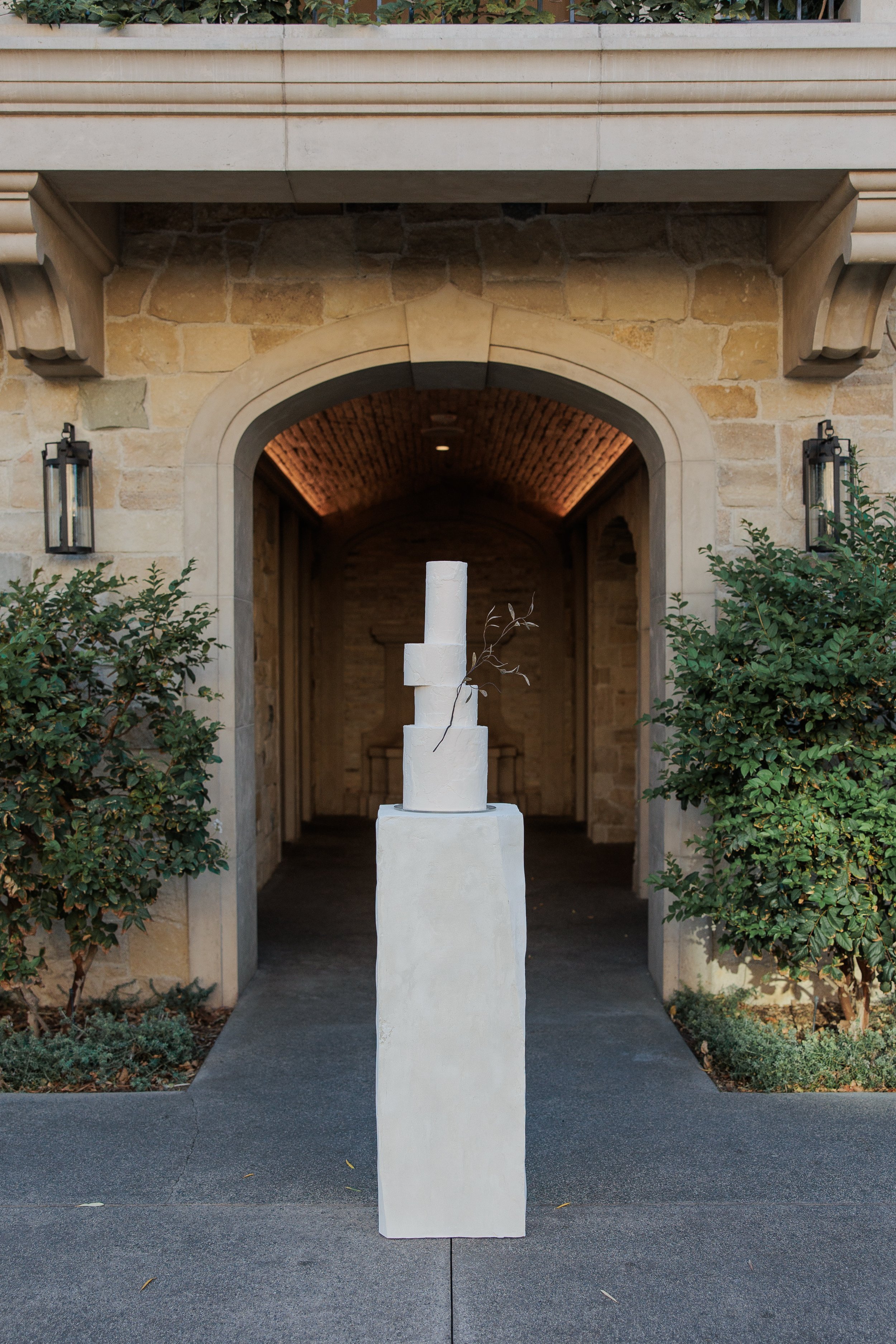
For context, if a couple commissioned a fully edible version of an architectural cake sculpture I created for an editorial at Monserate Winery, I would value a comparable wedding commission at approximately $6,000, depending on its final scale, construction, and culinary requirements.
Why such a significant difference?
Because 100 servings tells you how much cake is needed.
It doesn’t necessarily tell you what it takes to create the piece.
Why I Don’t Price Wedding Cakes by the Slice
Wedding cakes are traditionally priced by multiplying the number of servings by a fixed price per slice. For many bakeries, that system makes perfect sense.
It isn’t how I approach my work.
I see cake as a sculptural medium.
When a couple commissions a piece from me, they aren’t simply purchasing a particular quantity of dessert. I’m interpreting something about who they are together and translating it through proportion, movement, material, color, flavor, and form.
Pricing that work exclusively by servings would be a little like pricing a sculpture according to how much raw material it contains.
The material matters. But the amount of material alone doesn’t explain the value of what is created from it.
The artistic point of view, technical ability, experimentation, craftsmanship, and experience required to transform that material are what make the finished piece possible.
I think about wedding cakes in much the same way.
What Actually Determines the Cost of a Custom Wedding Cake?
Several factors influence the cost of an individually commissioned wedding cake, and many of them have surprisingly little to do with guest count.
1. The Creative Process
Before I begin physically making a cake, I spend time getting to know the couple.
I’m interested in who they are together—their personalities, history, shared experiences, the qualities they bring out in one another, and the atmosphere they want to create for their celebration.
During the tasting and design consultation, those conversations begin to take visual form. I’m listening for ideas that can become proportion, movement, material, botanical language, or composition.
A sketch may emerge from that process, but the work doesn’t necessarily stop evolving when the drawing is finished.
I keep the words and impressions from our conversations with me while I work. They continue to inform decisions as the sculpture develops.
Sometimes a piece doesn’t fully resolve until I’m physically assembling it.
That’s part of working through an artistic process rather than reproducing a predetermined design.
The goal is for the finished work to feel as though it could only belong to that particular couple.
2. Scale, Shape, and Engineering
The size of a wedding cake matters, but its structure can matter even more.
A relatively straightforward five-tier cake may be less technically demanding than a smaller sculpture with unusual proportions or construction.
Is the cake being carved into an unconventional form? Are elements extending beyond the central structure? Does the composition require custom internal supports? Are parts visually floating, cantilevered, offset, or otherwise behaving in ways cake ordinarily doesn’t?
Cake is an unusual sculptural material because it is both edible and structurally vulnerable.
Creating certain forms requires an understanding of weight distribution, material behavior, temperature, structure, and the limitations of the ingredients themselves.
What appears effortless in the finished piece may be the result of years of experimentation behind it.
3. Artistic Technique and Detail
Then there is the craftsmanship itself.
Some commissions may involve highly controlled architectural edges. Others may rely on delicate wafer-paper work, sculptural fondant, unusual surface treatments, handmade botanicals, or materials developed specifically for the piece.
When I create a botanical element, for example, I’m not simply reproducing the idea of a flower or leaf. I’m studying its structure, movement, proportion, translucency, irregularity, and the way it occupies space.
These are skills developed over years rather than hours.
The finished work may feel quiet or effortless, but creating that restraint can be extraordinarily labor-intensive.
4. Custom Flavor Development
Flavor is also part of the commission.
Rather than treating the tasting as a menu selection, I like to learn how a couple actually experiences food.
There may be a dessert connected to an early date, an ingredient associated with childhood, a place they traveled together, a family tradition, or simply a particular combination of flavors they’re drawn to.
Those references become starting points.
From there, the work is culinary: balancing richness with acidity, sweetness with bitterness, softness with texture, familiarity with something less expected.
A flavor might involve recipe development, specialty sourcing, testing, refinement, and several separate components before it becomes something cohesive.
The point isn’t to put meaningful ingredients together simply because they have a story.
It still has to be delicious.
The goal is for the flavor to feel personal and complete.
5. The Labor You Never See
A surprising amount of wedding cake production happens outside the moments anyone would recognize as “decorating.”
There is ingredient sourcing, shopping, recipe preparation, testing, administration, organization, structural planning, equipment preparation, cleaning, refrigeration management, packaging, transportation, and resetting the workspace between completely different stages of production.
A single artistic technique can involve hours of work followed by another substantial period of cleanup before the next stage can even begin.
Multiply those transitions across a complex commission and the hours accumulate quickly.
The visible finishing work is only one part of what it takes to create the final piece.
A $6,000 Wedding Cake Sculpture: The Monserate Design
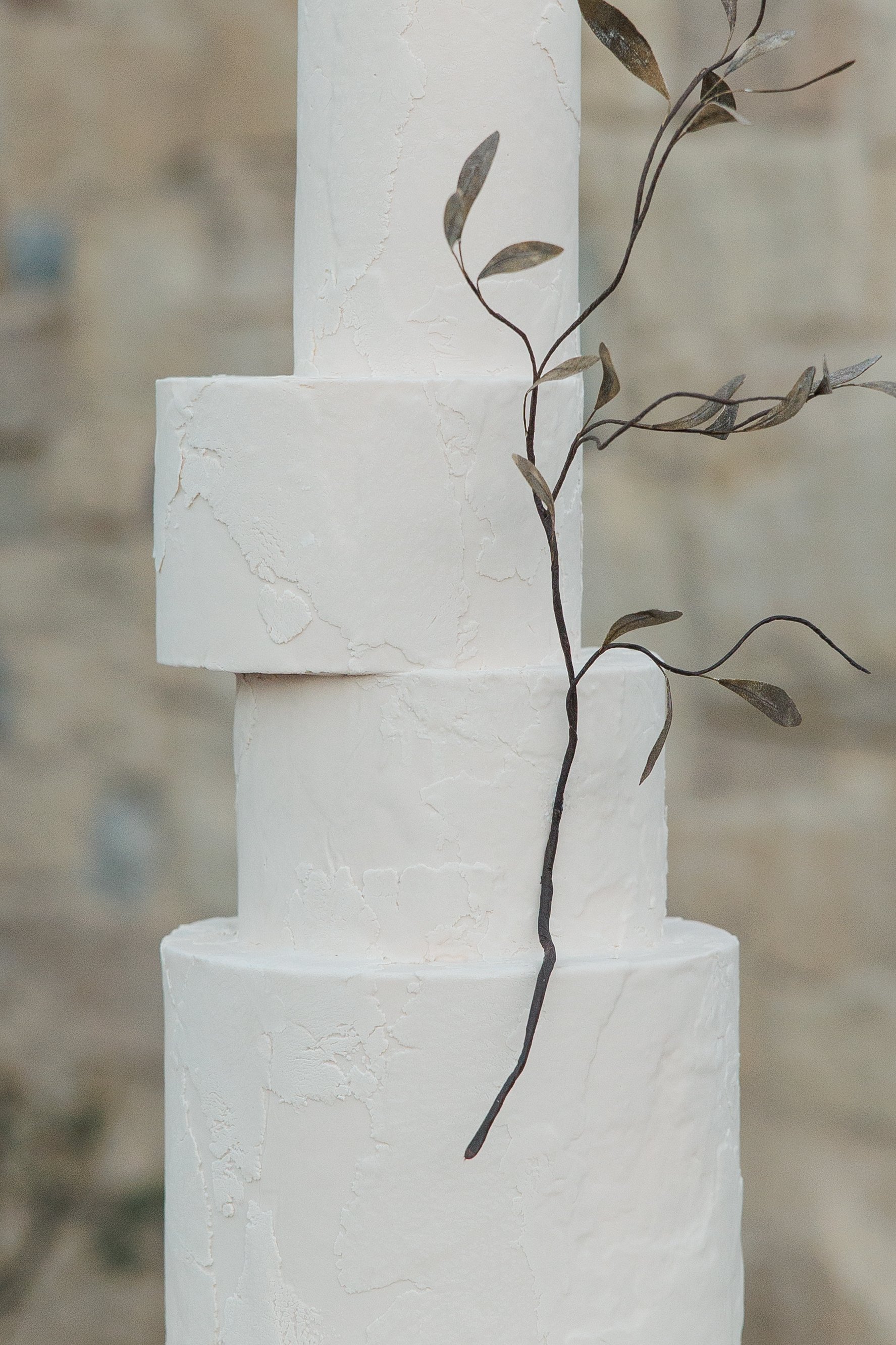
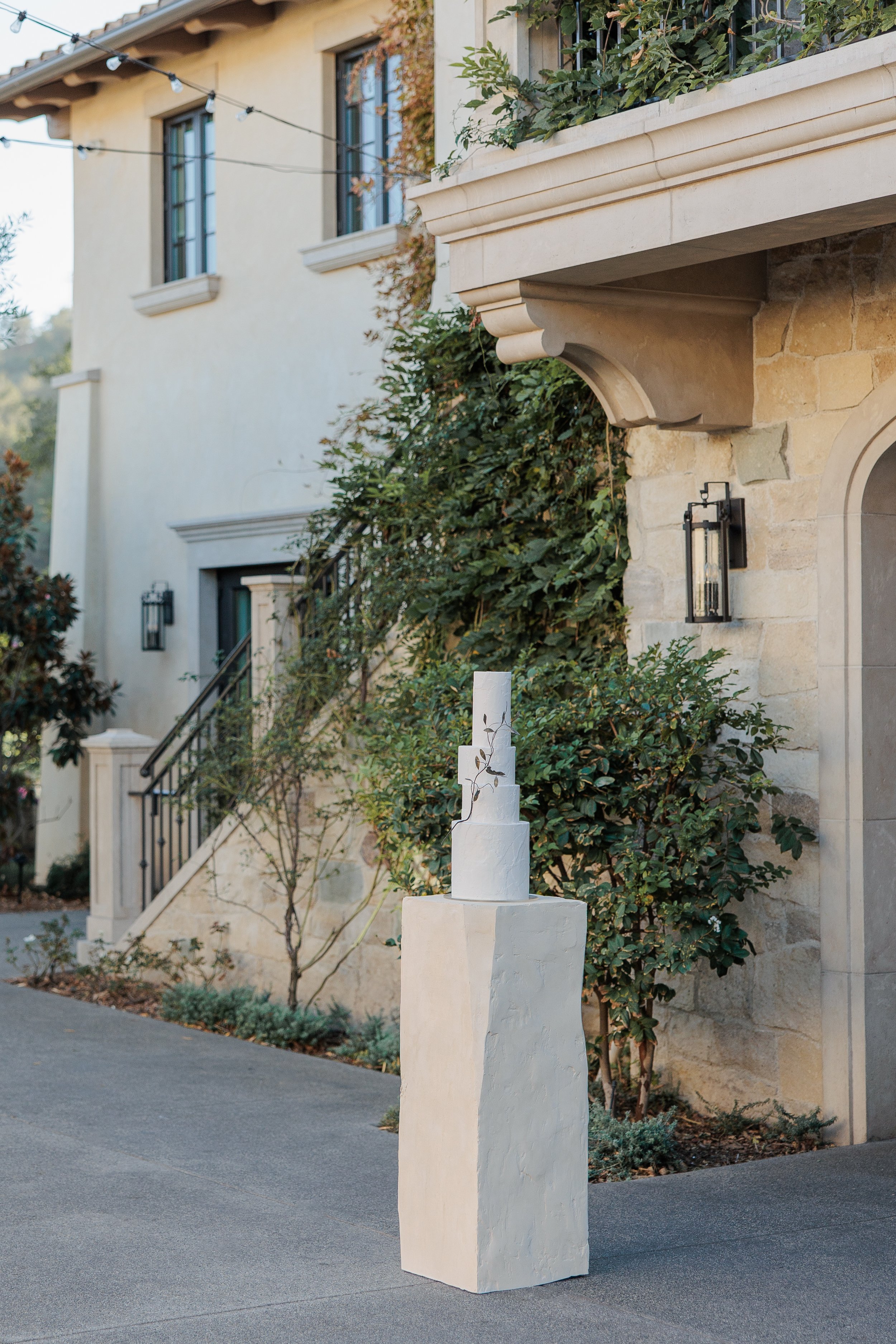
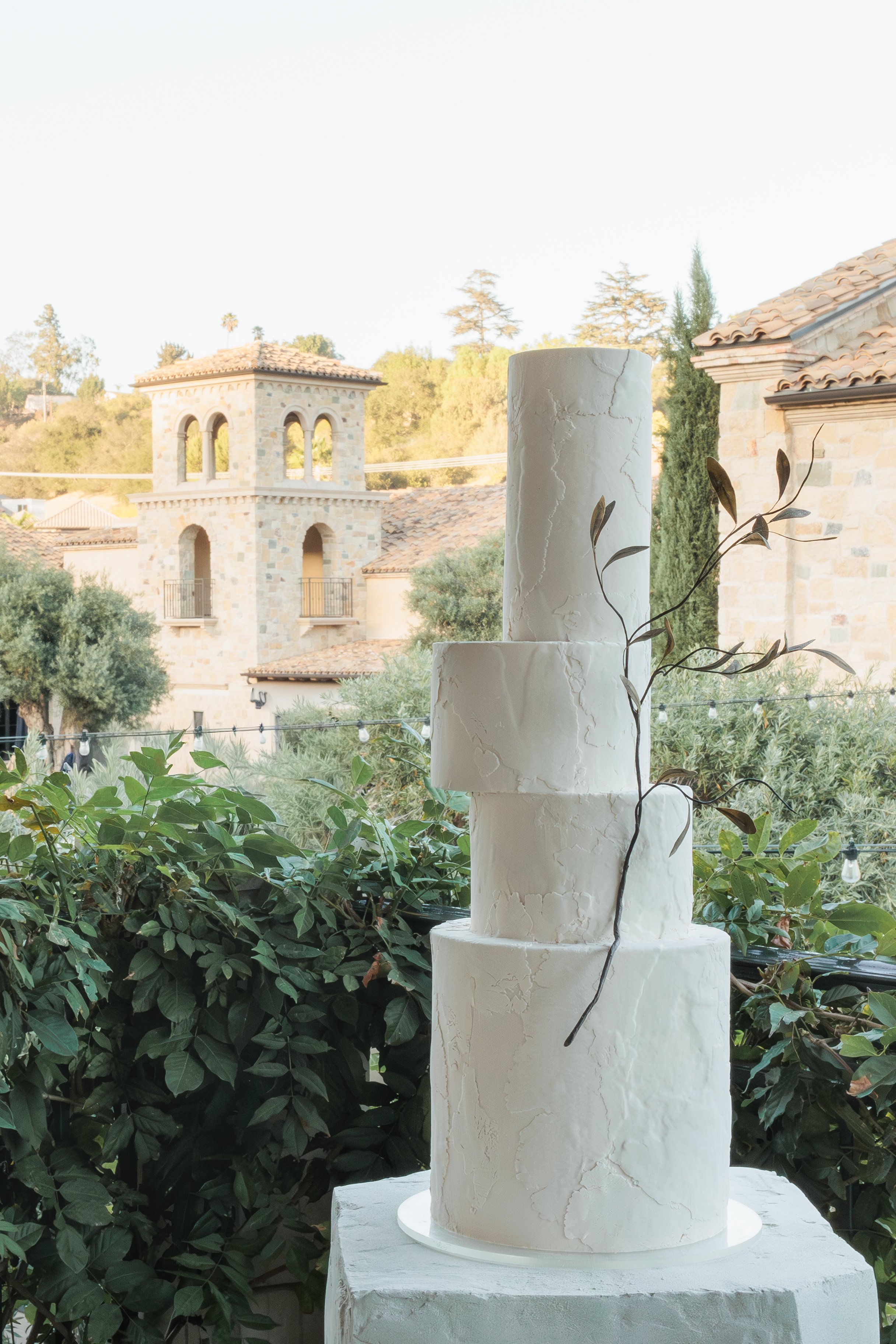
One example of how artistic complexity influences pricing is a cake sculpture I created for an editorial wedding shoot at Monserate Winery in Southern California.
Photos captured by Aubrey Rae Jones
Valued at approximately $6,000 as a wedding commission, the piece demonstrates why the number of servings alone isn’t always an accurate reflection of cost.
Rather than a traditional arrangement of stacked tiers, I explored a composition of intersecting columns, varied proportions, weathered Tuscan-inspired surfaces, and carefully considered negative space.
The relationship between the forms was essential.
Their positioning, height, texture, and balance created the architecture of the piece, while a handmade wafer-paper olive branch introduced organic movement through the geometry.
What made the sculpture demanding was not necessarily the quantity of cake involved.
It was the artistic and technical precision required to make the composition work.
Maintaining sharp architectural edges, creating convincing material textures, constructing unusual proportions, and balancing the individual forms required a very different process from producing a conventional tiered wedding cake.
The approximately $6,000 valuation reflects not only the finished object, but the complete experience of commissioning the work: the conversations, interpretation, design development, technical planning, craftsmanship, production, flavor, delivery, and installation required to bring it to life.
A sculpture like this could contain fewer servings than a conventional five-tier cake and still require considerably more artistic development and technical execution.
The number of servings tells you how much dessert you’re purchasing. It doesn’t necessarily tell you what it takes to create the artwork.
Does Your Wedding Cake Need to Serve All 100 Guests?
Not necessarily.
One of the most useful things couples can understand is that the size of the displayed wedding cake does not always need to correspond directly to the guest count.
If the artistic concept calls for a smaller or more particular proportion, enlarging the sculpture simply to produce additional servings can weaken the design.
Additional cake can instead be prepared separately for the venue’s kitchen to portion and serve.
This allows the displayed piece to retain the scale and proportions the design actually needs while still ensuring there is enough dessert for everyone.
The sculpture can be designed for the celebration first.
The serving requirements can then be solved around it.
How Can You Reduce the Cost Without Sacrificing the Design?
If a couple loves my work but is working within a particular budget, one of the first things I consider is scale.
I would much rather create a smaller piece that fully expresses the concept than enlarge or simplify a design until the thing that made it interesting has disappeared.
Reducing scale can sometimes lower material, structural, and production requirements while preserving the central idea.
Not every sculpture can simply be shrunk. Certain forms need enough physical space to work properly, and some techniques require a particular scale.
But when it makes sense, scale can be one of the most effective ways to reduce cost without compromising the artistic point of view.
The design should determine the sculpture’s proportions—not the guest count alone.
Why Can Luxury Wedding Cakes Cost So Much?
I think wedding cake artistry is often undervalued because most of us have an existing reference point for what “cake” costs.
We have purchased birthday cakes.
We have walked past bakery cases.
We have seen grocery-store cakes.
It is completely natural to begin there.
But there is a substantial difference between ordering a decorated cake and commissioning an artist to create an original sculpture for a wedding.
The latter involves years of technical experience, culinary knowledge, creative development, craftsmanship, and the ability to take something abstract—a relationship, atmosphere, memory, or feeling—and turn it into something physical.
That is a highly specialized service.
Couples regularly allocate substantial portions of their wedding budgets toward florals, fashion, photography, entertainment, lighting, stationery, and the environment of the reception itself.
The cake can occupy an equally interesting visual role.
That doesn’t mean every couple needs a sculptural wedding cake.
There is absolutely a place for a beautiful, straightforward bakery cake.
But I do think couples should understand the difference between those experiences before deciding what the cake is worth to them.
For some people, a delicious dessert is exactly what they want.
For others, commissioning an artist to create something completely specific to the two of them becomes part of the creative experience of the wedding itself.
Neither approach is wrong.
They are simply different things.
What Role Do You Want the Cake to Play?
Cake already has an unusual cultural role.
Think about a birthday.
The moment the cake comes out is often the moment everyone gathers around the person being celebrated. People sing. They take photographs. They stop what they’re doing.
The cake becomes part of the ritual.
A wedding gives us an opportunity to take that familiar object and ask it to do something more.
A particular curve might represent a quality one person brings into the relationship. A botanical form might reference a landscape or memory. A change in proportion could express balance, tension, contrast, or movement between two personalities.
Suddenly, the cake isn’t simply a beautiful object.
It becomes a conversation.
It gives guests another way to understand something about the people they came to celebrate.
That’s why I love seeing a commissioned cake given real presence within a reception—somewhere guests can approach it, see it from different angles, and experience it as part of the environment rather than discovering it only when it is time to cut.
So, How Much Should You Budget for a Wedding Cake for 100 Guests?
Ultimately, it depends on what you want the experience to be.
If your priority is serving a delicious dessert to 100 people, a traditional bakery may be the right choice, and the budget can reflect that.
If you are looking for an individually commissioned sculpture involving original design, personal interpretation, specialized craftsmanship, technical construction, and curated flavor development, the cost can reach several thousand dollars and beyond.
A complex architectural commission comparable to my Monserate sculpture, for example, would be valued at approximately $6,000, depending on the scale, construction, and culinary requirements of the final piece.
So rather than beginning only with the question, How much cake do we need for 100 people?, I encourage couples to ask something slightly different:
What role do we want the cake to play in our celebration?
Is it dessert?
Is it decoration?
Or could it become an artwork that captures something about who you are together?
For many couples, a wedding may be one of the few occasions in their lives when they commission an artist to make something entirely for them.
I think there is something extraordinary about that opportunity.
And when a wedding cake is approached that way, its value becomes about much more than what it costs per slice.
Connor Mansberger is the artist behind Connor Robert, a San Diego-based fine art wedding cake studio creating individually commissioned cake sculptures throughout Southern California and beyond. His work brings together sculptural design, technical craftsmanship, and personalized flavor development to create pieces shaped by the people and celebrations they belong to.